Data engineering resumes get judged on volume, latency, and trust. A backend engineer is asked whether the service stays up; a data engineer is asked whether the numbers are right, whether they arrived on time, and what happens when an upstream schema changes without warning. If your resume describes pipelines without describing scale or data quality, it reads as junior regardless of your years. This guide covers what to include and how to quantify it.
What hiring managers look for
- Scale, stated plainly — rows per day, terabytes processed, number of sources, job runtimes.
- Orchestration — Airflow, Dagster, or Prefect, including how you handled retries, backfills, and dependencies.
- Warehouse and modelling work — Snowflake, BigQuery, Redshift, and dbt; the transformation layer is where most of the job now sits.
- Data quality ownership — tests, contracts, freshness checks, and what you did when they failed.
- Cost awareness — warehouse spend is a board-level line item, and engineers who reduce it are memorable.
Python data engineer resume summary example
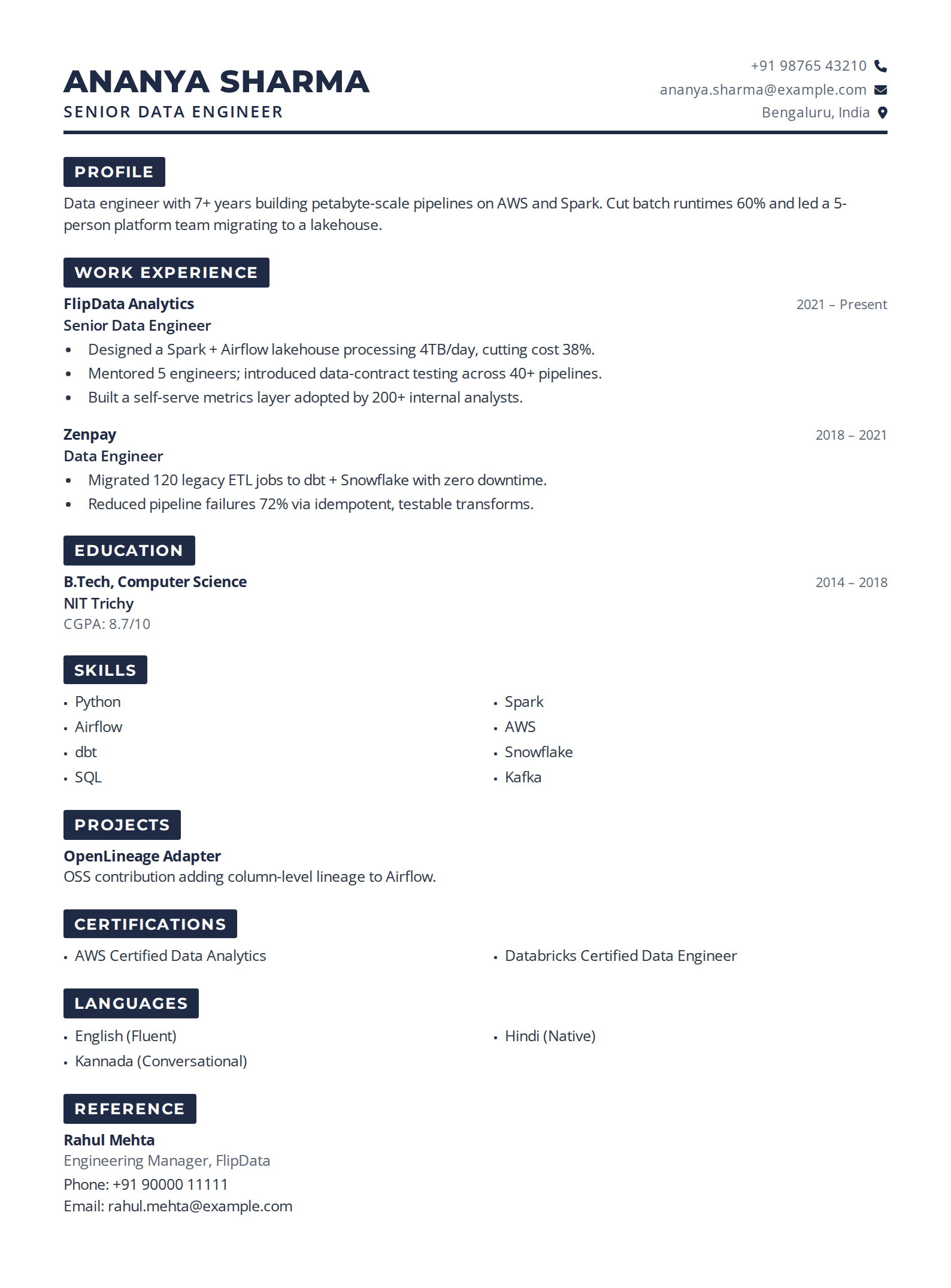
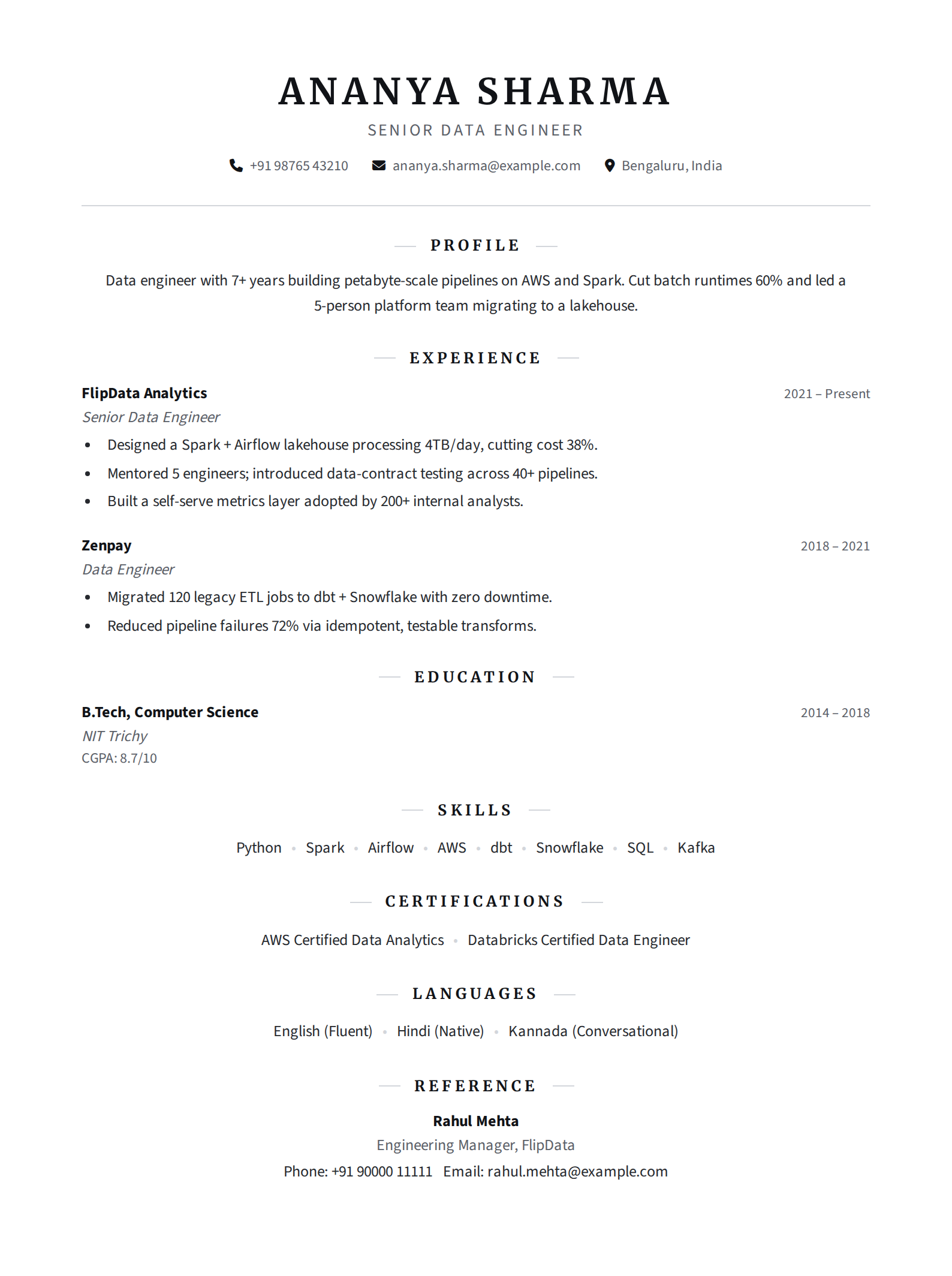
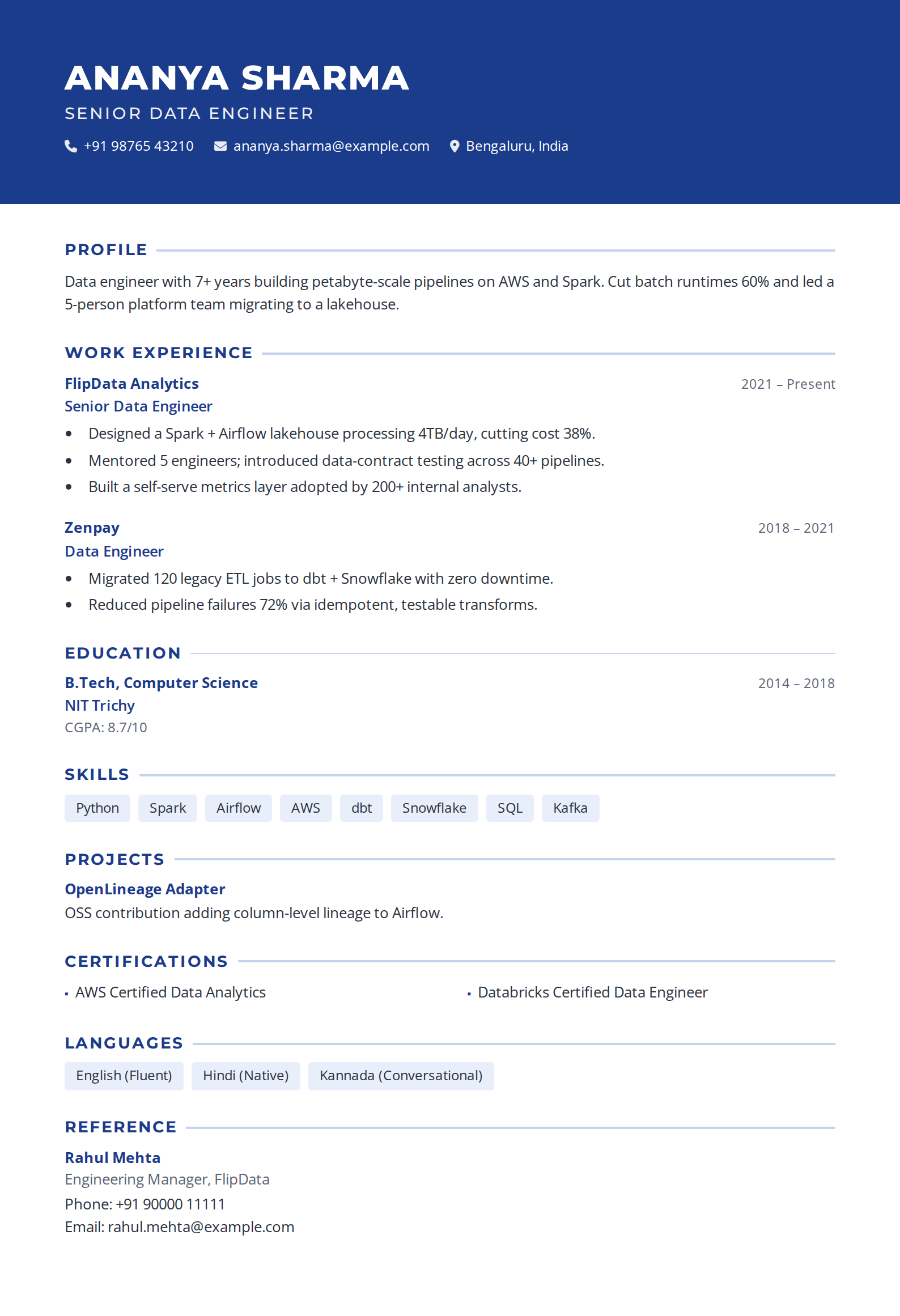
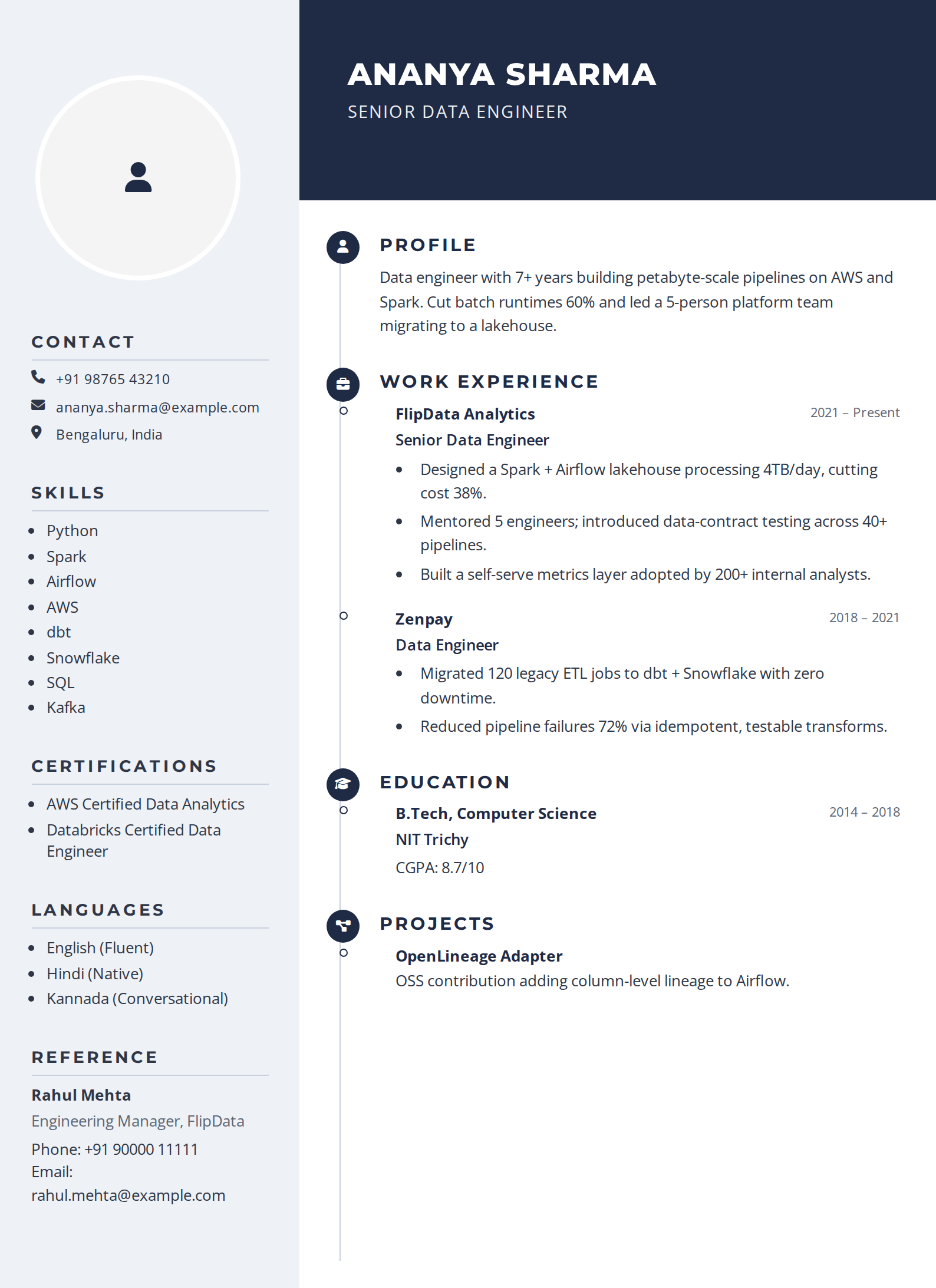
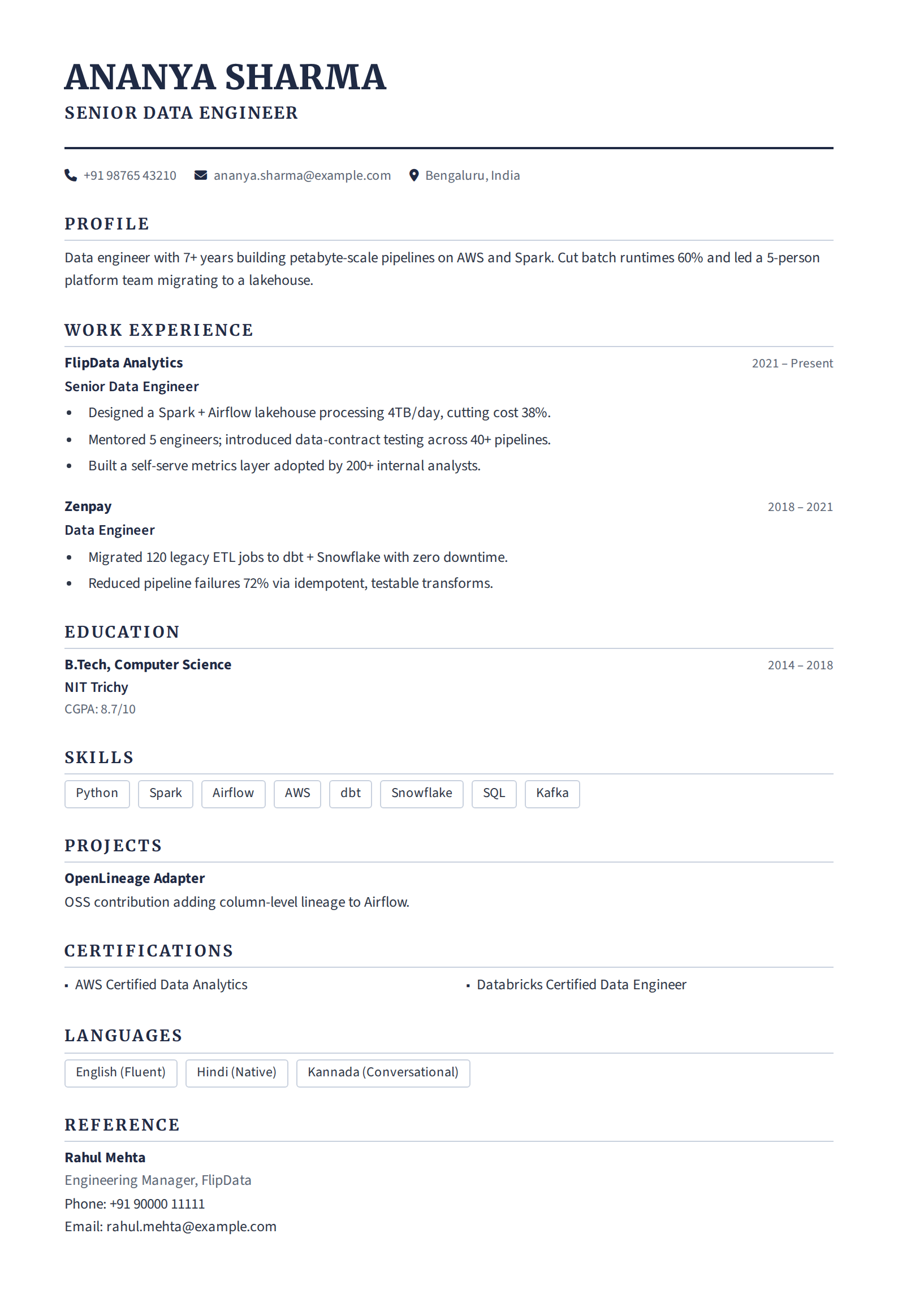
Data engineer with 6 years building Python pipelines on Airflow and dbt, processing 4TB and 900M events daily into Snowflake. Cut warehouse spend 38% by rewriting incremental models and pruning unused partitions. Owns data quality end to end — contracts, freshness SLAs, and on-call for 200+ production DAGs.
Skills and keywords for a data engineering resume
| Category | Examples to include (match the job post) |
|---|---|
| Languages | Python, SQL (advanced), Scala or Java if relevant, Bash |
| Processing | pandas, PySpark, Polars, Apache Beam, Flink |
| Orchestration | Airflow, Dagster, Prefect, Luigi, cron |
| Warehouses | Snowflake, BigQuery, Redshift, Databricks, Delta Lake |
| Transformation | dbt, SQLMesh, incremental models, dimensional modelling |
| Streaming | Kafka, Kinesis, Pub/Sub, change data capture, Debezium |
| Quality & infra | Great Expectations, data contracts, Terraform, Docker, S3, Parquet |
Advanced SQL is not optional. Data engineering interviews lean on window functions, CTEs, and query tuning far more than Python trivia — make sure SQL appears prominently, not as an afterthought at the end of a skills list.
Experience bullets that quantify properly
- Built and own 200+ Airflow DAGs ingesting 900M events daily from 40 sources into Snowflake, holding a 99.7% on-time completion SLA.
- Rewrote batch aggregations as incremental dbt models, cutting nightly runtime from 6 hours to 35 minutes and warehouse spend by 38% ($21k/month).
- Replaced a nightly batch load with Kafka change data capture via Debezium, reducing dashboard data latency from 24 hours to under 3 minutes.
- Introduced data contracts and freshness checks across 60 critical tables, cutting silently-wrong-data incidents from roughly 4 per month to 1 per quarter.
- Migrated 4TB of historical data from Redshift to Snowflake with dual-running validation, finishing with zero reconciliation discrepancies.
- Tuned PySpark jobs by fixing partition skew, cutting cluster cost per run 55% while halving runtime.
Moving into data engineering from another role
Most data engineers arrive from somewhere else. Lead with the overlap:
| Coming from | Foreground this | Close this gap |
|---|---|---|
| Backend / Python | Production ownership, testing, CI/CD, API integration | Warehouse modelling, dbt, orchestration |
| Data analyst | Advanced SQL, business context, stakeholder work | Python engineering practice, version control, pipelines |
| Data science | pandas, feature pipelines, notebook-to-production work | Orchestration, cost tuning, reliability and on-call |
| ETL / BI developer | Existing pipeline and warehouse experience | Modern stack — dbt, Airflow, cloud warehouses |
Tailoring your resume to a specific data engineering job
Data engineering postings vary more than most job families — the same title can mean streaming infrastructure at one company and dbt modelling at another. Sending one resume to all of them is why strong candidates get filtered out. Spend ten minutes per application:
- Identify which kind of role it is. Scan the posting for the centre of gravity: a warehouse and dbt stack, a streaming and Spark stack, or a platform and infrastructure stack.
- Reorder your skills. Put the group matching that stack first. Nothing else on the resume changes, but the first thing a reviewer reads now matches what they need.
- Promote the two most relevant bullets. Move them to the top of your most recent role; recruiters rarely read past the first two lines of each job.
- Mirror their vocabulary. If the posting says "data pipelines" rather than "ETL", use their phrasing — parsers match literal strings, not synonyms.
- Rewrite one line of your summary to name the stack and domain they work in.
What you should not do is invent experience with tools you have not used. Data engineering interviews go deep quickly, and a claimed Kafka background collapses in the first technical conversation.
Common mistakes on data engineering resumes
- No scale anywhere. "Built ETL pipelines" describes a student project and a petabyte platform identically. Always attach volume.
- Listing tools without outcomes. Naming Airflow, Spark, and Kafka proves exposure; runtime, cost, or reliability numbers prove capability.
- Burying SQL. It is the most-tested skill in the interview loop and belongs near the top.
- Ignoring data quality. Teams increasingly hire for trustworthiness of data over raw throughput — describe the checks you built.
- No cost figures. Warehouse savings are among the easiest wins to quantify and among the most memorable to a hiring manager.
Check your draft with a free ATS resume checker before applying. For general Python roles see the Python developer resume guide.
 Continue with Google